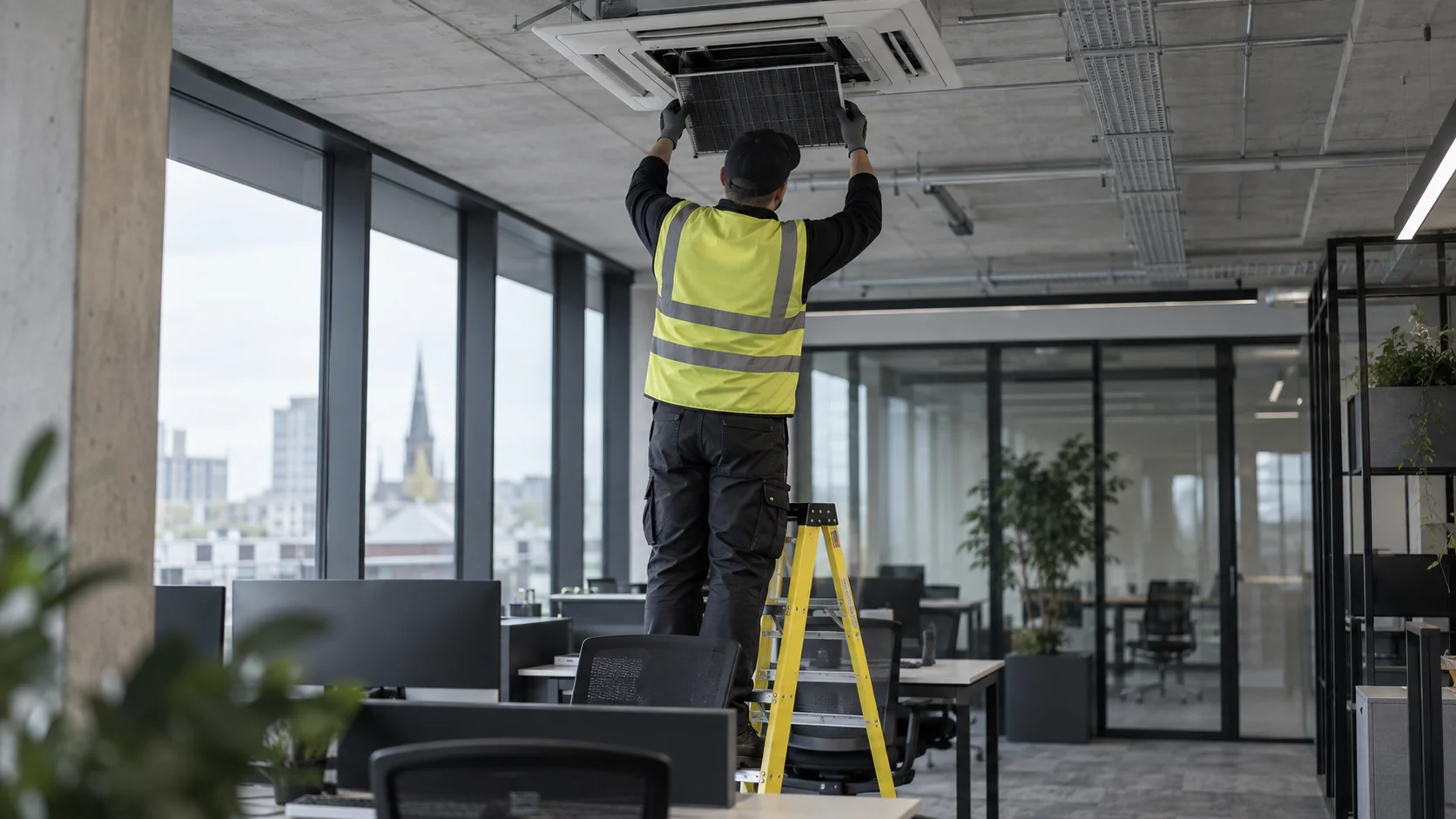
HSE's maintenance guidance supports planned work using manufacturer information and suitable competence. Record the scope, timing, access and required completion evidence for each activity in the programme.
Factors that change the service requirement
Continuous-duty equipment and a lightly occupied meeting room need different assessments. Review these factors before deciding the scope:
- Hours run and seasonal demand for heating or cooling.
- Dust or grease exposure affecting coils and filters.
- Condensate drainage condition and potential effects on occupied areas.
- Age, observed condition and recurring equipment faults.
- Safe access and workable shutdown periods.
- Operational consequences when heating or cooling is unavailable.
Assign timing to individual tasks, including filters, drainage, cleaning and detailed servicing. Use findings to review the plan: repeated contamination before the next visit calls for reassessment of the cleaning arrangement.
Routine servicing and F-gas leak checks are different
Routine service addresses condition and operation, whereas statutory F-gas leak checks concern refrigerant leakage within the applicable scope. They may share an attendance, but records must show separately which requirements were completed.
For Great Britain, government's F-gas leak-check guidance relates checking requirements to refrigerant quantity and global warming potential, with provisions for sealed equipment and leak detection. Verify refrigerant data and configuration against current rules; room count or the last general service cannot establish the legal interval.
Equipment outside a periodic leak-check requirement still needs appropriate maintenance. Equally, a leak-check record does not demonstrate that filters, drains and other service tasks were completed.
Respond to changes between planned visits
Report abnormal noise, leaks, recurring alarms or reduced performance between visits. Capture times, affected spaces and fault codes. Arrange assessment rather than repeatedly resetting the equipment or delaying investigation until the routine service.
Review demand after occupancy, partition or room-use changes. Maintenance alone cannot establish that the original installation remains suitable for the altered space.
Keep records that support the next decision
Record assets, completed tasks, findings, relevant measurements, outstanding repairs and next activities. Keep refrigerant evidence identifiable. At offices and hospitality premises, coordinate access with occupation and trading before confirming attendance.
Common questions
Is an annual service always enough?
Not necessarily. Manufacturer requirements, duty, environment and condition determine whether annual attention is sufficient; particular tasks may need shorter intervals.
Does cleaning the filters count as a complete service?
No. Filter work forms only part of the equipment’s required scope. Other specified checks and maintenance still need to be included and recorded.
Can leak checks and servicing happen together?
They can, where the due dates, work scope and appropriately qualified personnel align. Retain separate evidence identifying completion of each activity.
Should we service equipment that is rarely used?
Yes, as required by manufacturer instructions and applicable duties. Low operating hours do not resolve condition, shutdown, storage or restart requirements by themselves.
Related guidance and services
Review Air Conditioning, Planned Preventative Maintenance and Building Services Upgrades when defining the programme. Use condition-based maintenance to understand how findings inform future work.
Compare services, projects, sectors and locations. Discuss air-conditioning maintenance with asset details, operating hours and previous reports so the scope reflects the site.